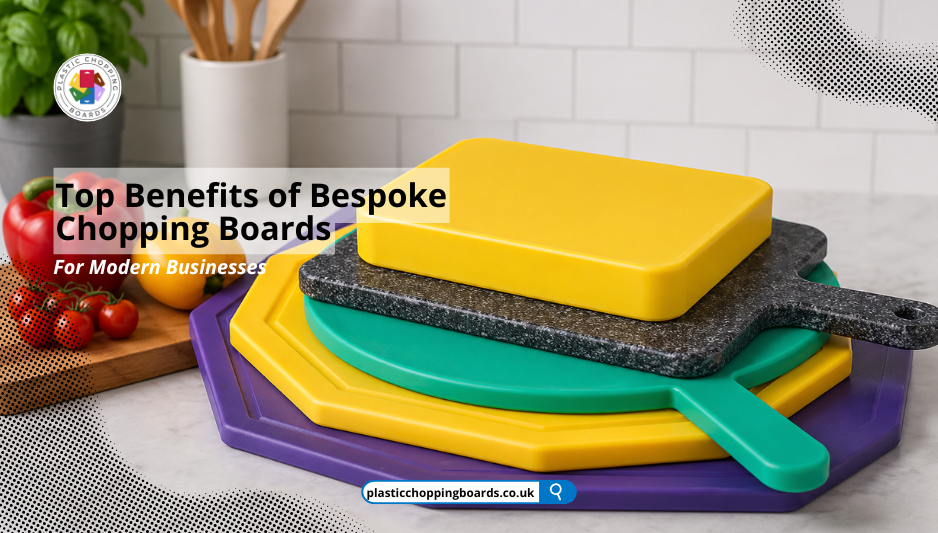
Most businesses buy whatever chopping boards are cheapest in bulk and call it done. It is an understandable approach. But it tends to create a slow, quiet set of problems that nobody really connects back to the boards themselves: prep stations that do not quite work, staff using the wrong board for the wrong food, sizes that never quite fit the worktop, and a kitchen that looks inconsistent on camera or in front of guests.
A personalised chopping board solves most of those problems in one go. Here is why more businesses are going bespoke rather than buying off the shelf.
What Are the Benefits of Bespoke Chopping Boards?
1. You Get the Exact Size You Actually Need
Standard boards come in standard sizes. Kitchens do not. A prep station that is 45cm wide does not want a 30cm board rattling around on it, and it definitely does not want a 60cm board hanging off the edge.
Custom-made chopping boards are cut to whatever dimensions suit your actual workspace. That sounds like a small thing until you have spent a week watching staff shuffle a board around every time they need more room. The right size stays put, creates a proper prep surface, and makes the whole workflow a bit calmer.
2. Colour Coding Becomes Genuinely Useful
The colour-coding system for chopping boards exists for a real reason. Raw meat, raw fish, cooked meat, vegetables, dairy, allergens — each has a designated colour in a professional kitchen, and mixing them up is a food safety issue, not just an inconvenience.
The problem with buying a standard colour set is that you often end up with sizes or thicknesses that do not match across colours. A custom chopping board lets you specify the same dimensions and thickness across every colour in your set, so the boards stack neatly, store consistently, and feel the same to use regardless of which one a chef picks up.
3. Your Kitchen Runs a Tighter Hygiene System
When boards are the wrong size or the wrong thickness, staff improvise. They use whatever is closest. That is where the colour-coding system breaks down in practice, even in kitchens that have it on paper.
A set of coloured chopping boards ordered to a consistent specification removes most of that improvisation. Each board fits its station, handles its food group, and gets cleaned and stored in the right place. HACCP compliance becomes easier to demonstrate because the system is physically consistent, not just written in a policy document nobody reads.
4. Thickness Can Be Matched to the Work
Not every prep task needs the same board. A 12mm board is fine for light slicing and vegetable prep. A 25mm board is what you want for heavy butchery work, where the knife goes in hard and repeatedly.
Buying off the shelf usually means picking one thickness and using it everywhere. Commercial chopping boards ordered to specification let you match thickness to task: thinner boards for lighter stations, heavier boards where the work demands it. The boards last longer because they are not being put through punishment they were not built for.
5. Large Prep Areas Finally Get a Board That Fits
Central production kitchens, catering units, and event caterers often work with prep surfaces that standard board sizes simply do not cover properly. A large personalised chopping board cut to cover a specific worktop section removes the gaps where food debris collects and gives a clean, uninterrupted prep surface across the whole area.
It also reduces the number of boards in use at once, which means fewer items to track, clean, and store during a busy service.
6. You Stop Replacing Boards So Often
Cheap boards look fine in the first few weeks. Then the grooves start showing up, the boards warp after a few dishwasher cycles, and you are ordering again six months later. That cycle is more expensive than it looks when you add it up across a full year.
A personalised plastic chopping board made from industrial-grade polyethylene, the kind used by commercial meat and poultry processors, holds its surface far longer. It does not warp in the dishwasher. The knife grooves develop more slowly because the material is denser than cheaper LDPE alternatives. You spend less on replacements and spend less time managing stock.
7. You Can Specify Extras That Actually Get Used
Juice grooves are a good example. They are on plenty of boards but often in the wrong position, or the groove is too shallow to be useful. When you order a chopping board personalised to your kitchen’s needs, you can specify whether you want a juice groove, where it runs, and how deep it goes.
The same applies to shape. Most boards are rectangular because that is the default, not because it is always the best option for the space. Bespoke orders can be round, paddle-shaped, or cut to a specific profile that suits a particular station or presentation style.
8. Branding Becomes Part of the Kitchen
This one matters more in hospitality than in most other sectors. When a board appears on a pass, on a sharing platter, or in a cooking video, it is visible. A custom chopping boards page visit from a hotel, restaurant, or bar often starts with exactly this: the realisation that the boards the kitchen currently uses look fine for prep but terrible on camera or in front of guests.
Ordering boards in a specific colour, finish, or shape that fits the brand aesthetic of the venue is a small detail that adds up across a dining room or a catering operation.
9. Ordering in Bulk Gets Easier and More Consistent
When a business buys boards off the shelf from multiple sources over time, the collection gradually becomes inconsistent. Different thicknesses, slightly different sizes, different finishes. Staff notice, even if they do not say anything.
Ordering commercial chopping boards to a fixed specification means every board in the kitchen matches every other board of the same type. Replacements are identical to the originals. New locations or stations can be equipped with exactly the same setup as existing ones without hunting around for something that approximates the right size.
The Process Is Simpler Than Most People Expect
The main reason businesses stick with off-the-shelf boards is the assumption that going bespoke involves a complicated process, long lead times, or minimum orders too large to justify.
In practice, ordering custom-made chopping boards is usually a case of specifying colour, size, thickness, and any extras like a juice groove. You get a quote, approve it, and the boards are made and dispatched. For businesses that have never looked at a custom chopping board option before, the process tends to be a straightforward one-off conversation rather than a drawn-out procurement exercise.
If your current boards are not quite working for your kitchen, that conversation is probably worth having.